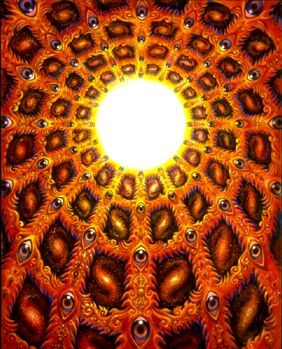
THE light that you seek is within you. So the search is going to be an inward search. It is not a journey to some goal in the outer space; it is a journey in the inner space. You have to reach your core. That which you are seeking is already within you. You just have to peel the onion: layers and layers of ignorance are there. The diamond is hidden in the mud; the diamond is not to be created. The diamond is already there -- -only the layers of mud have to be removed.
This is very basic to understand: the treasure is already there. Maybe you don't have the key. The key has to be found, but not the treasure. This is basic, very radical, because the whole effort will depend on this understanding. If the treasure has to be created. then it is going to be a very long process; and nobody can be certain whether it can be created or not. Only the key has to be found. The treasure is there, just nearby. A few layers of locks have to be removed.
That's why the search for truth is negative. It is not a positive search. You are not to add something to your being; rather you have to delete something. You have to cut something from you. The search for truth is surgical. It is not medical; it is surgical. Nothing is to be added to you; rather on the contrary, something has to be removed from you, negated. Hence, the method of the Upanishads: neti, neti. The meaning of neti, neti is: go on negating until you reach to the negator; go on negating until there is not any possibility to negate, only you are left, you in your core, in your consciousness which cannot be negated -- because who will negate it? So go on negating, "I am neither this nor that." Go on. "neti, neti...." Then a point comes when only you are, the negator; there is nothing else to cut anymore, the surgery is over; you have come to the treasure.
If this is understood rightly, then the burden is not very heavy; the search is very light. You can move easily, knowing well all the time on the way that the treasure may be forgotten, but it is not lost. You may not be able to know where exactly it is, but it is within you. You can rest assured; there is no uncertainty about it. In fact even if you want to lose it you cannot lose it, because it is your very being. It is not something external to yoU; it is intrinsic.
People come to me and they say, "We are in search of God.' I ask them, "Where have you lost him? Why are you seeking? Have you lost him somewhere? If you have lost him somewhere, then tell me where you have lost him, because only there will you be able to find him." They say, "No, we have not lost him." Then why are you seeking? Then just close your eyes. Maybe because of the search you cannot find him. Maybe you are much too concerned with seeking; you have not looked at your own inner being: that the king of kings is sitting there already, waiting for you to come home. And you are a great seeker so you are going to Mecca and Medina, Kashi, and Kailash. You are a great seeker. You are going all over the world, except one place -- where you are. The seeker is the sought... when one is quiet and still.
Nothing new is achieved. One simply starts understanding that looking out was the whole point of missing. Looking in, it is there. It has always been there. There has never been a single moment when it was not there -- and there will never be a single moment -- because God is not external, truth is not external to you: it is you glorified; it is you in your total splendor; it is you in your absolute purity. If you understand this, then these sutras of Patanjali will be very simple.
BY PRACTICING THE DIFFERENT STEPS OF YOGA FOR THE DESTRUCTION OF IMPURITY, THERE ARISES SPIRITUAL ILLUMINATION WHICH DEVELOPS INTO AWARENESS OF REALITY.
He is not saying that something is to be created; he is saying something is to be destroyed. You are already more than your being -- this is the problem. You have gathered too much around you, the diamond has gathered too much mud. The mud has to be washed away. And, suddenly, there is the diamond. "By practicing the different steps of yoga for the destruction of impurity...." It is not a creation of purity or holiness or divineness; it is just a destruction of impurity. Pure you are. Holy you are. The whole path becomes totally different. Then a few things have to be cut and dropped; a few things have to be eliminated.
Deep down this is the meaning of sannyas, renunciation. It is not to renounce the house, not to renounce the family, not to renounce the children -- that looks too cruel. And how can a man of compassion do it? It is not to renounce the wife, because that is not the problem at all. The wife is not obstructing God; neither are the children creating barriers nor the house. No, if yoN renounce them you have not understood. Renounce something else that you have been gathering within yourself.
If you want to renounce the house, renounce the real house; that is, the body in which you live and reside. And by renouncing I don't mean go and commit suicide, because that won't be renouncing. Just knowing that you are not the body is enough. There is no need to be cruel to the body also. You may not be the body, but the body is also of God. You may not be the body, but the body is alive on its own. It also partakes of life; it is part of this totality. Don't be cruel to it. Don't be violent to it. Don't be a masochist.
Religious people almost always become masochists. Or they were already -- religion becomes a Rationalization and they start torturing themselves. Don't be a self-torturer. There are two types of torturers and violent people: one, sadists who torture other -- the politicians, Adolf Hitlers; and then there are self-torturers -- so-called religious people, saints, mahatmas, who torture themselves -- they are masochists. Both are the same: the violence is the same. Whether you torture anybody else's body or your own makes no difference -- you torture all the same.
Renunciation is not self-torture. If it is self-torture it is only politics standing on its head. It may be you are so cowardly you cannot manage to torture others, so you can torture only your own body. Ninety-nine out of one hundred so-called religious people are self-torturers, cowards. They wanted to torture others, but there was fear and danger and they couldn't do it. So they have found a very innocent victim, vulnerable, helpless: their own body. And they torture it in millions of ways.
No, renunciation means knowledge; renunciation means awareness; renunCiation means realization -- realization of the fact that you are not the body. It is finished. You live in it knowing well that you are not it. Unidentified, body is beautiful. It is one of the greatest mysteries in existence. It is the very temple where the king of kings is hiding.
When you understand what renunciation is, you understand this is neti, neti. You say, "I am not this body, because I am aware of the body; the very awareness makes me separate and different.' Go deeper. Go on peeling the onion: "I am not the thoughts, because they come and go but I remain. I am not the emotions... " They come, sometimes very strong, and you forget yourself completely in them, but they go. There was a time they were not, you were; there was a time they were, and you were hidden in them. There is again a time when they have gone and you are sitting there. You cannot be them. You are separate.
Go on peeling the onion: no, body you are not; thinking you are not; feeling you are not. And if you know that you are not these three layers, your ego simply disappears without leaving a trace behind -- because your ego is nothing but identification with these three layers. Then you are, but you cannot say "I." The word loses meaning. The ego is not there; you have come home.
This is the meaning of sannyas: it is negating all that you are not but are identified with. This is the surgery. This is the destruction.
"By practicing the different steps of yoga for the destruction of impurity...." And this is impurity: thinking yourself to be that which you are not is the impurity. Don't misunderstand me. because there is always a possibility you may misunderstand that the body is impure. I am not saying that. You can have pure water in one container and pure milk in another. Mix both: now the mixture is not doubly pure. Both were pure: water was pure. was exactly from the Ganges, and the milk was pure. Now you mix two purities and one impurity is born -- not that the purity is doubled. What has happened? Why do you call this mixture of water and milk impure? Impurity means the entering of the foreign element, that which does not belong to it, which is not natural to it, which is an intruder, which has trespassed its territory. It is not only that the milk is impure, the water is also impure. Two purities meet and become impure.
So when I say renounce the impurities, I don't mean that your body is impure, I don't mean that your mind is impure, I don't mean even that your feeling is impure. Nothing is impure -- but when you get identified, in that identification is impurity. Everything is pure. Your body is perfect if it functions on its own and you don't interfere. Your consciousness is pure if it functions on its own and the body does not interfere. If you live in a noninterfering existence you are pure. Everything is pure. I'm not condemning the body. I never condemn anything. Make it a point to be remembered always: I am not a condemner. Everything is beautiful as it is. But identification creates the impurity.
When you start thinking you are the body, you have intruded upon the body. And when you intrude upon the body, the body immediately reacts and intrudes upon you. Then there is impurity.
Says Patanjali, "By practicing the different steps of yoga for the destruction of impurity...." For the destruction of identity, identification; for the destruction of the mess that you have got in -- the chaos, where everything has become everything else. Nothing is clear. No center is functioning on its own; you have become a crowd. Everything goes on interfering into each other's nature. This is impurity.
".. for the destruction of impurity, there arises a spiritual illumination.. " And once the impurity is destroyed, suddenly there is illumination. It doesn't come from outside; it is your innermost being in its purity, in its innocence, in its virginity. A luminosity arises in you. Everything is clear: the crowds of confusion gone, the clarity of perception arises. Now you can see everything as it is: there are no projections. there is no imagination, there is no perversion of any reality. You simply see things as they are. Your eyes are vacant, your being silent. Now, you don't have anything in you, so you cannot project. You become a passive onlooker, a witness, a sakshin -- and that is the purity of being. "... there arises spiritual illumination which develops into awareness of reality."
Then, the eight steps of yoga. Follow me very slowly, because here is the central teaching of Patanjali:
Yam, niyam, asan, pranayam, pratyahar, dharana, dhyan. samadhiya ashto angani.
THE EIGHT STEPS OF YOGA ARE: YOM, SELF-RESTRAINT; NIYAM. FIXED OBSERVANCE; ASAN, POSTURE; PRANAYAM, BREATH REGULATION; PRATYAHAR, ABSTRACTION; DHARANA, CONCENTRATION; DHYAN, CONTEMPLATION; SAMADHI, TRANCE.
The eight steps of yoga. This is the whole science of yoga in one sentence, in one seed. Many things are implied. First, let me tell you the exact meaning of each step. And remember, Patanjali calls them steps and limbs, both. They are both. Steps they are because one has to be followed by another, there is a sequence of growth. But they are not only steps: they are limbs of the body of yoga. They have an internal unity, an organic unity also, that is the meaning of limbs.
For example, my hands, my feet, my heart -- they don't function separately. They are not separate; they are an organic unity. If the heart stops, the hand will not move then. Everything is joined together. They are not just like steps on a ladder, because every rung on the ladder is separate. If one rung is broken the whole ladder is not broken. So Patanjali says they are steps, because they have a certain, sequential growth -- but they are also angas. Limbs of a body, organic. You cannot drop any of them. Steps can be dropped; limbs cannot be dropped. You can jump two steps in one jump, you can drop one step, but limbs cannot be dropped; they are not mechanical parts. You cannot remove them. They make you. They belong to the whole; they are not separate. The whole functions through them as a harmonious unit.
So these eight limbs of yoga are both steps, steps in the sense that each follows the other, and they are in a deep relationship. The second cannot come before the first -- the first has to be first and the second has to be second. And the eighth will come to be the eighth -- it cannot be the fourth, it cannot be the first. So they are steps and they are an organic unity also.
Yam means self-restraint. In English the word becomes a little different. Not a little different, really, the whole meaning of yam is lost -- because in English self-restraint looks like suppressing, repressing. And these two words, suppression and repression, after Freud, have become four-letter words, ugly. Self-restraint is not repression. In the days when Patanjali used the word yam it had a totally different meaning. Words go on changing. Even now, in India also, samyam, which comes from yam, means control, repression. The meaning is lost.
You may have heard an anecdote. It is said about King George I of England that he went to see St. John's Cathedral when it was built. It was a masterpiece of art. The builder, the architect, the artist, was present there; his name was Christopher Wren. The king looked at him and complimented him. He said three words: he said, "It is amusing. It is awful. It is artificial." Christopher Wren was so delighted with the compliments... but you will be simply surprised. Those words don't have the same meaning anymore. In those days, three hundred years before, amusing used to mean amazing, awful used to mean awe-inspiring, and artificial used to mean artistic.
Each word has a biography, and it changes many times. As life changes, everything changes: the words take new colors. And, in fact, the words which have the capacity to change, only they remain alive; otherwise they go dead. Orthodox words, reluctant to change, they die. Alive words, who have the capacity to collect a new meaning around them, only they live; and they live in many, many meanings, for centuries. Yam was a beautiful word in Patanjali's days, one of the beautiful.... After Freud, the word has become ugly -- not only the meaning has changed, but the whole flavor, the whole taste of the word.
To Patanjali self-restraint does not mean to repress oneself. It simply means to direct one's life -- not to repress the energies, but to direct, to give them a direction. Because you can live such a life, which goes on moving in opposite directions, in many directions -- then you will never reach anywhere. It is just like a car: the driver goes a few miles to the north, then changes the mind; goes a few miles to the south, then changes the mind; then goes a few miles to the west, then changes the mind; and goes on this way. He will die where he was born. He will never reach anywhere. He will never have the feeling of fulfillment. You can go on moving in many ways, but unless you have a direction you are moving uselessly. You will feel more and more frustrated and nothing else.
To create a self-restraint means, first, to give a direction to your life energy. Life energy is limited. If you go on using it in absurd. undirected ways, you will not reach anywhere. You will be emptied of the energy sooner or later -- and that emptiness will not be the emptiness of a Buddha; it will be simply a negative emptiness. nothing inside, an empty container. You will be dead before you are dead. But these limited energies that have been given to you by nature, existence, God, or whatsoever you like to call it; these limited energies can be used in such a way that they can become the door for the unlimited. If you move rightly, if you move consciously, if you move alert, gathering all your energies and moving in one direction, if you are not a crowd but become an individual -- that is the meaning of yam.
Ordinarily you are a crowd, many voices inside. One says, "Go to this direction"; another says, "That is useless. Go to this." One says, "Go to the temple"; another says, "The theater will be better. And you are never at ease anywhere because wherever you are, you will be repenting. If you go to the theater the voice that was for the temple will go on creating trouble for you: "What are you doing here wasting your time? You would have been in the temple... and prayer is beautiful. And nobody knows what is happening there -- and, nobody knows, this may have been the opportunity for your enlightenment and you have missed." If you go to the temple, the same -- the voice that was insisting to go to the theater will go on saying: "What are you doing here? Like a foolish man you are sitting here. And you have prayed before and nothing happens. Why are you wasting your time?" And all around you you will see fools sitting and doing useless things -- nothing happens. In the theater who knows what excitement. what ecstasy was possible? You are missing.
If you are not an individual, a unitary being, wherever you are, you will always be missing. You will never be at home anywhere You will always be going somewhere or other and never arriving anywhere. You will become mad. The life which is against yam will become mad. It is not surprising that in the West more mad people exist than in the East. The East -- knowingly, unknowingly -- still follows a life of a little self-restraint. In the West to think about self-restraint looks like becoming a slave; to be against self-restraint looks like you are free, independent. But unless you are an individual you cannot be free. Your freedom will be a deception; it will be nothing but suicide. You will kill yourself, destroy your possibilities, your energies; and one day you will feel that the whole life you tried so much but nothing has been gained, no growth has come out of it.
Self-restraint means, the first meaning: to give a direction to life. Self-restraint means to become a little more centered. How can you become a little more centered? Once you give a direction to your life, immediately a center starts happening within you. Direction creates the center; then the center gives direction. And they are mutually fulfilling.
Unless you are self-restrained, the second is not possible -- that s why Patanjali calls them steps. The second is niyam, fixed observance: a life which bas a discipline, a life which has a regularity about it, a life which is lived in a very disciplined way, not hectic. Regularity... but that too will sound to you like slavery. All beautiful words of Patanjali's time have become ugly now. But I tell you, unless you have a regularity in your life, a discipline, you will be a slave of your instincts -- and you may think this is freedom, but you will be a slave of all the vagrant thoughts. That is not freedom. You may not have any visible master, but you will have many invisible masters within you; and they will go on dominating you. Only a man who has a regularity about him can become the master someday.
That too is far away still, because the real master happens only when the eighth step is achieved -- that is the goal. Then a man becomes a jina, a conqueror. Then a man becomes a Buddha, one who is awakened. Then a man becomes a Christ, a savior, because if you are saved, suddenly, you become a savior for others. Not that you try to save them: just your presence is a saving influence. The second is niyam, fixed observance.
The third is posture. And every step comes out of the first, the preceding one: when you have regularity in life, only then can you attain to posture, asan. Try asan sometimes; just try to sit silently. You cannot sit -- the body tries to revolt against you. Suddenly you start feeling pain here and there. The legs are going dead. Suddenly you feel, on many spots of the body, a restlessness. You had never felt it. Why is it that just sitting silently so many problems arise? You feel ants are crawling up. Look, and you will see there are no ants; the body is deceiving you. The body is not ready to be disciplined. The body is spoiled. The body does not want to listen to you. It has become its own master. And you have always followed it. Now, even to sit silently for a few minutes has become almost impossible.
People pass through such hell if you tell them to just sit silently. If I say this to somebody he says, "Just to sit silently, not doing anything?" -- as if "doing" is an obsession. He says, "At least give me a mantra so I can go on chanting inside." He needs some occupation. Just sitting silently seems to be difficult. And that is the most beautiful possibility that can happen to a man: just sitting silently doing nothing.
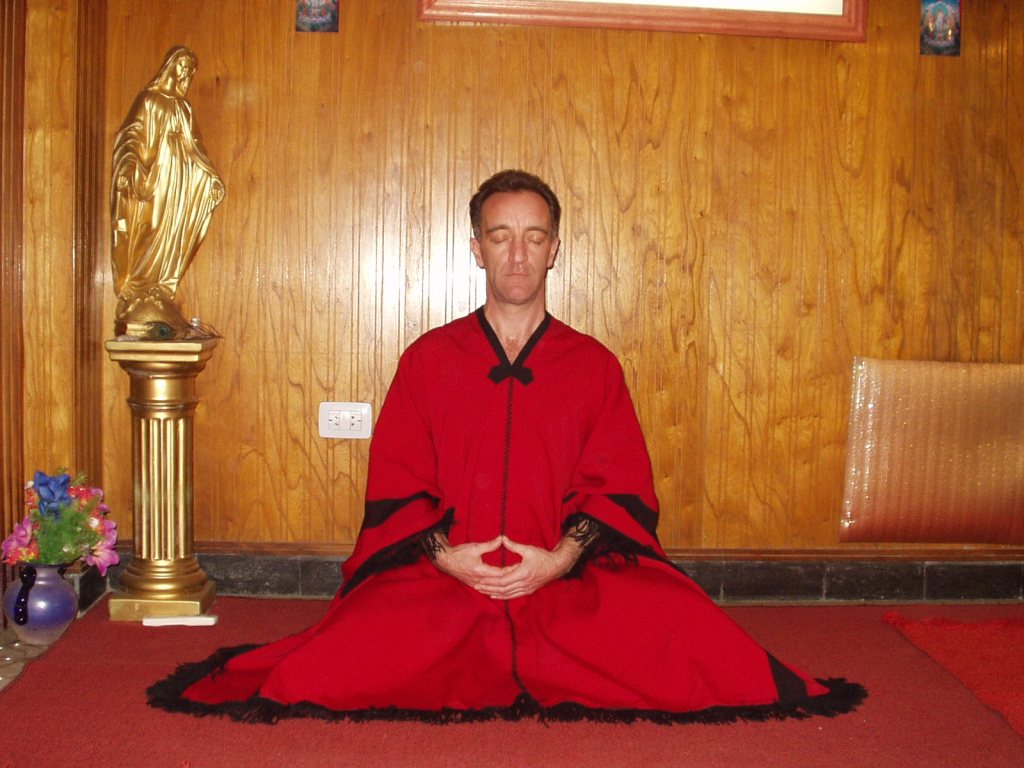
Asan means a relaxed posture. You are so relaxed in it, you are so restful in it, that there is no need to move the body at all. In that moment, suddenly, you transcend body.
The body is trying to bring you down when the body says, "Now look, many ants are crawling on," or you suddenly feel an urge to scratch, itching. The body is saying, "Don't go so far away. Come back. Where are you going?" -- because the consciousness is moving upwards, going far away from the bodily existence. Hmm?... the body starts revolting. You have never done such a thing. The body creates problems for you because once the problem is there, you will have to come back. The body is asking for your attention: "Give your attention." It will create pain. It will create itching; you will feel like scratching. Suddenly the body is no longer ordinary; the body is in revolt. It is a body politics. You are being called back: "Don't go so far away, be occupied. Remain here" -- remain tethered to the body and to the earth. You are moving towards the sky, and the body feels afraid.
Asan comes only to a person who lives a life of restraint, fixed observance, regularity; then posture is possible. Then you can simply sit because the body knows that you are a disciplined man. If you want to sit, you will sit -- nothing can be done against you. The body can go on saying things... by and by it stops. Nobody is there to listen. It is not suppression; you are not suppressing the body. On the contrary, the body is trying to suppress you. It is not suppression. You are not saying anything for the body to do; you are simply resting. But the body does not know any rest because you have never given rest to it. You have always been restless. The very word asan means rest, to be in deep rest; and if you can do that, many things will become possible to you.
If the body can be in rest, then you can regulate your breathing You are moving deeper, because breath is the bridge from the body to the soul, from the body to the mind. If you Can regulate breathing -- that is pranayam -- you have power over your mind.
Have you ever watched that whenever the mind changes, the rhythm of the breath immediately changes? If you do the opposite -- if you change that rhythm of the breath -- the mind has to change immediately. When you are angry you cannot breathe silently; otherwise the anger will disappear. Try. When you are feeling angry your breath goes chaotic, it becomes irregular, loses all rhythm, becomes noisy, restless. It is no longer a harmony. A discord starts being there; the accord is lost. Try one thing: whenever you are getting angry just relax and let the breath be in rhythm. Suddenly you will feel the anger has disappeared. The anger cannot exist without a particular type of breathing in your body.
When you are making love the breath changes, becomes very violent. When you are very much filled with sexuality, the breath changes, becomes very violent. Sex has a little violence in it. Lovers are known to bite each other and sometimes harm each other. And if you see two persons making love, you will see that some sort Or fighting is going on. There is a little violence in it. And both are breathing chaotically; their breathings are not in rhythm, not in unison.
In tantra, where much has been done about sex and the transformation of sex, they have worked very much on the rhythm of the breath. If two lovers, while making love, can remain in a rhythmic breathing, in unison, that both have the same rhythm, there will be no ejaculation. They can make love for hours, because ejaculation is possible only when the breath is not in rhythm; only then can the body throw the energy. If the breath is in rhythm, the body absorbs the energy; it never throws it out. Tantra developed many techniques of changing the rhythm of breath. Then you can make love for hours and you don't lose energy. Rather on the contrary you gain, because if a woman loves a man and a man loves a woman, they help each other to be recharged -- because they are opposite energies. When opposite energies meet and spark, they charge each other; otherwise energy is lost and, after the lovemaking, you feel a little cheated, deceived -- so much promise and nothing comes in hand, the hands remain empty.
After asan comes breath regulation, prarayam. Watch for a few days and just take notes: when you become angry what is the rhythm of your breathing -- whether exhalation is long or inhalation is long or they are the same, or inhalation is very small and exhalation very long, or exhalation very small, inhalation very long. Just watch the proportion of inhalation and exhalation. When you are sexually aroused, watch, take a note. When sometimes sitting silently and looking at the sky in the night, everything is quiet around you. just take note of how your breath is going. When you are feeling filled with compassion, watch, note down. When you are in a fighting mood, watch, note down. Just make a chart of your own breathing. and then you know much.
And pranayam is not something which can be taught to you. You have to discover it because everybody has a different rhythm to his breathing. Everybody's breathing and its rhythm is as much different as thumbprints. Breathing is an individual phenomenon, that's why I never teach it. You have to discover your own rhythm. Your rhythm may not be a rhythm for somebody else, or may be harmful for somebody else. Your rhythm -- you have to find.
And that is not difficult. There is no need to ask any expert. Just keep a chart for one month of all your moods and states. Then you know which is the rhythm where you feel most restful, relaxed, in a deep let-go; which is the rhythm where you feel quiet, calm, collected, cool; which is the rhythm when, suddenly, you feel blissful. filled with something unknown, overflowing -- you have so much in that moment, you can give to the whole world and it will not be exhausted. Feel and watch the moment when you feel that you are one with the universe, when you feel the separateness is there no more, a bridge. When you feel one with the trees and the birds. and the rivers and the rocks, and the ocean and the sand -- watch You will find that there are many rhythms of your breath, a great spectrum: from the most violent, ugly, miserable hell-type, to the most silent heaven-type.
And then when you have discovered your rhythm, practice it -- make it a part of your life. By and by it becomes unconscious; then you only breathe in that rhythm. And with that rhythm your life will be a life bf a yogi: you will not be angry, you will not feel so sexual, you will not feel so filled with hatred. Suddenly you will feel a transmutation is happening to you.
Pranayam is one of the greatest discoveries that has even happened to human consciousness. Compared to pranayam, going to the moon is nothing. It looks very exciting, but it is nothing, because even if you reach to the moon, what will you do there? Even if you reach to the moon you will remain the same. You will do the same nonsense that you are doing here. Pranayam is an inner journey. And pranayam is the fourth -- and there are only eight steps. Half the journey is completed on pranayam. A man who has learned pranayam, not by a teacher -- because that is a false thing, I don't approve of it -- but by his own discovery and alertness, a man who has learned his rhythm of being, has achieved half the goal already. Pranayam is one of the most significant discoveries.
And after pranayam, breath regulation, is pratyahar, abstraction. Pratyahar is the same as I was talking to you about yesterday. The "repent" of Christians is, in fact, in Hebrew "return" -- not repent but return, going back. The toba of Mohammedans is nothing; it is not "repenting." That too has become colored with the meaning of repentance; toba is also returning back. And pratyahar is also returning back, coming back -- coming in, turning in, returning home. After pranayam that is possible -- pratyahar -- because pranayam will give you the rhythm. Now you know the whole spectrum: you know in what rhythm you are nearest to home and in what rhythm you are farthest from yourself. Violent, sexual, angry, jealous, possessive, you will find you are far away from yourself; in compassion, in love, in prayer, in gratitude, you will find yourself nearer home. After pranayam, pratyahar, return, is possible. Now you know the way -- then you already know how to step backwards.
Then comes dharana. After pratyahar, when you have started coming back nearer home, coming nearer your innermost core, you are just at the gate of your own being. pratyahar brings you near the gate; pranayam is the bridge from the out to the in. Pratyahar, returning, is the gate, and then is the possibility of dharana, concentration. Now you can become capable of bringing your mind to one object. First, you gave direction to your body; first, you gave direction to your life energy -- now you give direction to your consciousness. Now the consciousness cannot be allowed to go anywhere and everywhere. Now it has to be brought to a goal. This goal is concentration, dharana: you fix your consciousness on one point.
When consciousness is fixed on one point thoughts cease, because thoughts are possible only when your consciousness goes on wavering -- from here to there, from there to somewhere else. When your consciousness is continuously jumping like a monkey, then there are many thoughts and your whole mind is just filled with crowds -- a marketplace. Now there is a possibility -- after pratyahar, pranayam, there is a possibility -- you can concentrate on one point.
If you can concentrate on one point, then the possibility of dhyan. In concentration you bring your mind to one point. In dhyan you drop that point also. Now you are totally centered, nowhere-going -- because if you are going anywhere it is always going out. Even a single thought in concentration is something outside you -- object exists; you are not alone, there are two. Even in concentration there are two: the object and you. After concentration the object has to be dropped.
All the temples lead you only up to concentration. They cannot lead you beyond because all the temples have an object in them: the image of God is an object to concentrate on. All the temples lead you only up to dharana, concentration. That's why the higher a religion goes, the temple and the image disappear. They have to disappear. The temple should be absolutely empty, so that only you are there -- nobody, nobody else, no object: pure subjectivity.
Dhyan is pure subjectivity, contemplation -- not contemplating "something," because if you are contemplating something it is concentration. In English there are no better words. Concentration means something is there to concentrate upon. Dhyan is meditation: nothing is there, everything dropped, but you are in an intense state of awareness. The object has dropped, but the subject has not fallen into sleep. Deeply concentrated, without any object, centered -- but still the feeling of "I" will persist. It will hover. The object has fallen, but the subject is still there. You still feel you are.
This is not ego. In Sanskrit we have two words, ahankar and asmita. Ahankar means "I am." And asmita means 'am.' Just "amness" -- no ego exists, just the shadow is left. You still feel, somehow, you are. It is not a thought, because if it is a thought. that "I am," it is an ego. In meditation the ego has disappeared completely; but an amness, a shadowlike phenomenon, just a feeling, hovers around you -- just a mist-like thing, that just in the morning hovers around you. In meditation it is morning. the sun has not risen yet, it is misty: asmita, amness, is still there.
You can still fall back. A slight disturbance -- somebody talking and you listen -- meditation has disappeared; you have come back to concentration. If you not only listen but you have started thinking about it, even concentration has disappeared; you have come back to pratyahar. And if not only are you thinking but you have become identified with the thinking, pratyahar has disappeared; you have fallen to pranayam. And if the thought has taken so much possession of you that your breathing rhythm is lost, pranayam has disappeared: you have fallen to asan. But if the thought and the breathing are so much disturbed that the body starts shaking or becomes restless. Asan has disappeared. They are related.
One can fall from meditation. Meditation is the most dangerous point in the world, because that is the highest point from where you can fall, and you can fall badly. In India we have a word, yogabhrasta: one who has fallen from yoga. This word is very, very strange. It appreciates and condemns together. When we say somebody is a yogi, it is a great appreciation. When we say somebody is yogabhrasta, it is also a condemnation: fallen from the yoga. This man had attained up to meditation somewhere in his past life and then fell down. From meditation the possibility of going back to the world is still there -- because of asmita, because of amness. The seed is still alive. It can sprout any moment; so the journey is not over.
When asmita also disappears, when you no longer know that you are -- of course, you are but there is no reflection upon it, that "I am," or even amness -- then happens samadhi, trance, ecstasy. Samadhi is going beyond; then one never comes back. Samadhi is a point of no return. From there nobody falls. A man in samadhi is a god: we call Buddha a god, Mahavir a god. A man in samadhi is no longer of this world. He may be in this world, but he is no longer of this world. He doesn't belong to it. He is an outsider. He may be here, but his home is somewhere else. He may walk on this earth, but he no longer walks on the earth. It is said about the man of sAMADHI he lives in the world but the world does not live in him.
These are the eight steps and eight limbs together. Limbs because they are so interrelated and so organically related; steps because you have to pass one by one -- you cannot start from just anywhere: you have to start from yam.
Now a few more things, because this is such a central phenomenon for Patanjali you have to understand a few things more. Yam is a bridge between you and others; self-restraint means restraining your behavior. Yam is a phenomenon between you and others, you and the society. It is a more conscious behavior: you don't react unconsciously, you don't react like a mechanism, like a robot. You become more conscious; you become more alert. You react only when there is absolute necessity; then too you try so that that reaction should be a response and not a reaction.
A response is different from a reaction. The first difference is: a reaction is automatic; a response is conscious. Somebody insults you: immediately you react -- you insult him. There has not been a single moment's gap to understand: it is reaction. A man of self-restraint will wait, listen to his insult, will think about it.
Gurdjieff used to say that his whole life changed because when his grandfather was dying, Gurdjieff was just nine years of age, he called him and told him, "I am a poor man and I have nothing to give to you, but I would like to give something. The only thing that I have been carrying like a treasure is this, this was given to me by my own father.... You are very young, but remember it. Someday you will understand -- just you remember it. Someday you will understand. Right now I don't hope you can understand, but if you don't forget, someday you will understand." And this is the thing he told to Gurdjieff "If somebody insults you, answer him after twenty-four hours have elapsed."
It became a transformation, because how can you react after twenty-four hours? Reaction needs immediacy. Gurdjieff says, "Somebody will insult me or somebody will say something wrong, and I will have to say, 'I will come tomorrow. Only after twenty-four hours am I allowed to answer -- and I have given a promise to my grandfather and he is dead, and the promise cannot be taken back. But I will come.'" That man should be taken aback. He will not be able to understand what is the matter.
And Gurdjieff will think about it. The more he will think, the more useless it will look. Sometimes it will be felt that the man is right, whatsoever he has said is true. Then Gurdjieff will go and thank the man, "You brought to light something of which I was unaware." Sometimes he will come to know that the man is absolutely wrong. And when the man is absolutely wrong, why bother? Nobody bothers about lies. When you feel hurt, there must be some truth in it; otherwise you don't feel hurt. Then too there is no point in going.
And he said, "It came to pass that many times I tried my grandfather's formula, and by and by anger disappeared" -- and not only anger -- by and by he became aware that the same technique can be used for other emotions: and everything disappeared. Gurdjieff was one of the highest peaks that has been attained in this age, a Buddha. And the whole journey started with a very small step, the promise given to an old man dying. It changed his whole life.
Yam is the bridge between you and others -- live consciously; relate with people consciously. Then the second two, niyam and asan -- they are concerned with your body. Third, pranayam is again a bridge. As the first, yam, is a bridge between you and others, the second two are a preparation for another bridge -- your body is made ready through niyam and asan -- then pranayam is the bridge between the body and the mind. Then pratyahar and dharana are the preparation of the mind. Dhyan again, is a bridge between the mind and the soul. And samadhi is the attainment. They are interlinked, a chain; and this is your whole life.
Your relation with others has to be changed. How you relate has to be transformed. If you continue to relate with others in the same way as you have always been doing, there is no possibility to change. You have to change your relationship. Watch how you behave with your wife or with your friend or with your children. Change it. There are a thousand and one things to be changed in your relationship. That is yam, a control -- but control, not suppression. Through understanding comes control. Through ignorance one goes on forcing and suppressing. Always do everything with understanding and you never harm yourself or anybody else.
Yam is to create a congenial environment around yourself. If you are inimical to everybody -- fighting, hateful, angry -- how can you move inwards? All these Things will not allow you to move. You will be so much disturbed on the surface that that inner journey will not be possible. To create a congenial, a friendly, atmosphere around you is yam. When you relate with others beautifully, consciously, they don't create trouble for you in your inner journey. They become helps; they don't hinder you. If you love your child, then when you are meditating he will not disturb you. He will say to others, "Keep quiet. Pop is meditating." But if you don't love your child, you are simply angry, then when you are meditating he will create all sorts of nuisances. He wants to take revenge -- unconsciously. If you love your wife deeply, she will be helpful; otherwise she won't allow you to pray, she won't allow you to meditate -- you are going beyond her control.
This I see every day: The husband takes sannyas. The wife comes crying -- "What have you done to our family? You have destroyed." I know the husband has not loved the wife; otherwise she would have been happy. She would have celebrated that her husband has become meditative. But he has not loved her. Now, not even has he not loved, he is moving inwards; so there will be no possibility in the future also of any love coming from him. If you love a person, the person is always helpful for your growth because he knows, or she knows, that the more you grow, the more you will be capable of love. She knows the taste of love. And all meditations will help you to love more, to be more beautiful in every way. But this happens every day.
It happened to Sheela's sister. She was in a camp and she wanted to take sannyas, but the husband was not willing. The husband is a very, very educated man, hmm?... director of a research institute somewhere in America. Then she went home. There was constant fight. She wanted to take sannyas, she wanted to be initiated, but he wouldn't allow. Then he came to see me -- "Who is this man who has been disturbing our life?" And he took sannyas. Now the wife is creating trouble! Now the wife is absolutely against. And he is a very simple man, really beautiful. And he goes on writing to me: "What to do? -- because I love her, but she has completely changed since she has heard that I have taken sannyas." This is how things go. Everybody is making an effort to control the other.
A man of yam controls himself, not others. To others he gives freedom. You try to control the other and never yourself. A man of yam controls himself, gives freedom to others -- loves so much that he can give freedom, and he loves himself so much that he controls himself. This has to be understood: he loves himself so much that he cannot dissipate his energies; he has to give a direction.
Then, niyam and asan are for the body. A regular life is very healthy for the body because the body is a mechanism. You confuse the body if you lead an irregular life. Today you have taken your food at one o'clock, tomorrow you take at eleven o'clock, day after tomorrow you take at ten o'clock -- you confuse the body. The body has an inner biological clock; it moves in a pattern. If you take your food every day at exactly the same time, the body is always in a situation where she understands what is happening. and she is ready for the happening -- the juices are flowing in the stomach at the right moment. Otherwise, whenever you want to take the food, you can take, but the juices will not be flowing. And if you take the food and the juices are not flowing, then the food becomes cold; then the digestion is difficult.
The juices must be ready there to receive the food while it is hot, then immediately absorption starts. Food can be absorbed in six hours if the juices are ready, waiting. If the juices are not waiting, then it takes twelve hours to eighteen hours. Then you feel heavy, lethargic. Then the food gives you life, but does not give you pure life. It feels like a weight on your chest; you somehow carry, drag. And food can become such pure energy -- but then a regular life is needed.
You go to sleep every day at ten o-clock: the body knows -- exactly at ten o'clock the body gives you an alarm. I'm not saying become obsessive -- that when your mother is dying then too you go at ten o'clock. I'm not saying that. Because people can become obsessive....
There are many stories about Immanuel Kant. He became obsessive about regularity; it became a madness. Don't create an obsession. He had a fixed routine, so fixed, second to second, that if somebody, a guest has come, he will look at the clock and he will not even say anything to the guest, because that saying will take time -- he will jump into the bed, cover himself with the blanket, and he has gone to sleep and the guest is sitting there. The servant will come and say, "Now you go, because that was his time." The servant became so atuned to Kant that there was no need to say, "Your food is ready," and no need to say. "Now you go to sleep." Only the time had to be said. The servant will come in the room and say, "lt is eleven o'clock, sir." So he will follow immediately because there was no need to say anything.
He was so regular that the servant became the dictator -- because he will always threaten him, "I will leave. Raise my pay." immediately, the pay has to be raised because another servant, a new man, will disturb. Once they tried also: a new man came, but it was not possible, because Kant was living second to second.
He would go to the university; he was a great teacher and a great philosopher. One day the road was muddy and it was raining, and one of his shoes got stuck in the mud -- so he left it there. Otherwise he will be late. So he went with one shoe on. It was said in the university area of Konigsberg that people looking at him would fix their watches, because everything was absolutely clock wise.
A new neighbor purchased the house adjacent to Kant's house and he started planting new trees. Every day at exactly five o'clock in the evening, Kant used to come to that side of the house and sit near the window and look at the sky. Now the trees covered the window and he could not look at the sky. He fell sick. He fell so sick... and the doctors could not find anything wrong with him, because he was such a regular man. He was really tremendously healthy. They could not find anything; they couldn't diagnose. Then the servant said, "You don't bother. I know the reason. Those trees are intruding on his regularity. Now he cannot go to the window and sit there and look at the sky. Looking at the sky is no longer possible." The neighbour had to be persuaded. The trees were cut, and he was okay; the illness disappeared.
But this is obsession. No need to become obsessive; everything has to be done with understanding.
Niyam and asan, regularity and posture: they are for the body. A controlled body is a beautiful phenomenon -- a controlled energy, glowing, and always more than is needed, and always alive, and never dull and dead. Then the body also becomes intelligent, body also becomes wise, body glows with a new awareness.
Then, pranayam is a bridge: deep breathing is the bridge from mind to body. You can change the body through breathing; you can change the mind through breathing. Pratyahar and dharana, returning home and concentration, belong to the transformation of the mind. Then, dhyan is again a bridge from mind to the self, or to the no-self -- whatsoever you choose to call it, it is both. Dhyan is the bridge of samadhi.
The society is there; from the society to you there is a bridge: yam. The body is there; for the body: regularity and posture. Again there is a bridge, because of the different dimension of mind from the body: pranayam. Then, the training of the mind: pratyahar and dharna, returning back home and concentration. Then again a bridge, this is the last bridge: dhyan. And then you reach the goal: samadhi.
Samadhi is a beautiful word. It means now everything is solved. It means samadhan: everything is achieved. Now there is no desire; nothing is left to achieve. There is no beyond; you have come home.



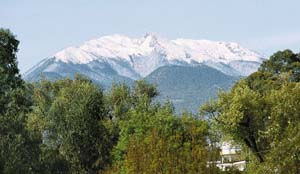
 Tlalpan
is the largest of the 16 boroughs into which
Tlalpan
is the largest of the 16 boroughs into which

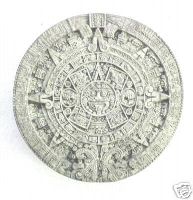 Bosque de
Tlalpan
Bosque de
Tlalpan

 Comentarios
y Sugerencias
Comentarios
y Sugerencias



















 ENERGY ENHANCEMENT
Option number ONE
28 days WITH 30
INITIATIONS, FOUR LEVELS, 4997 UK POUNDS - SAVE TIME, SAVE TRANSPORT - SAVE 1000
UK POUNDS.
ENERGY ENHANCEMENT
COURSE FOUR LEVELS
Start on the 28TH of
July finish on the 23RD of August
ENERGY ENHANCEMENT
Option number ONE
28 days WITH 30
INITIATIONS, FOUR LEVELS, 4997 UK POUNDS - SAVE TIME, SAVE TRANSPORT - SAVE 1000
UK POUNDS.
ENERGY ENHANCEMENT
COURSE FOUR LEVELS
Start on the 28TH of
July finish on the 23RD of August



)